Europe dreams of autonomy in orbit. Yet, despite growing ambitions for strategic autonomy in space, Europe continues to bear structural dependencies that limit its ability to be an independent actor in space. Major investments have been made to strengthen Europe’s space industry and improve its launch capabilities and access to navigation and communication systems from space. However, dependence on U.S space capabilities leaves it vulnerable to shifts in American foreign policy.
Europe’s space governance is shared between national governments and intergovernmental bodies linked to the EU. The key actors are the EU, the European Space Agency (ESA), and EU Member States. The EU provides the political and regulatory framework, while ESA – an intergovernmental organization with both EU and non-EU members – leads scientific and technical programs. Member States contribute to both the EU and ESA but also maintain their own national space policies and agencies.
Both the EU and ESA recognize the strategic nature of space, and that greater emphasis should be put on autonomy amid broader geopolitical changes. In fact, the EU has been working towards strategic autonomy for years, with the EU Space Programme playing a central role in that effort. Strategic autonomy in space involves reducing dependency on foreign providers by developing sovereign launch capabilities and investing in secure satellite constellations. In this context, Europe’s challenge is not one of the strategies, but one of execution. While the rhetoric from European leaders praising strategic autonomy has grown louder, the operational reality remains constrained by industrial fragmentation and risk aversion.
A Security Frontier above Earth
The limits of Europe’s strategic autonomy in space became apparent during Russia’s full-scale invasion of Ukraine: On the day of the attack on Ukraine, Russia launched a cyberattack disrupting modems that communicated with Viasat Inc’s KA-SAT satellite network. The attack was targeted towards the Ukrainian military uses of satellite communications, ultimately not providing a military advantage to Russia. The attack demonstrated that space is now an interconnected battlespace, where cyber and physical warfare converge—and where commercial systems can become military targets.
When SpaceX’s CEO Elon Musk threatened to restrict Ukrainian access to Starlink in 2022, it underscored a deeper vulnerability: a deepening transatlantic security gap could see U.S. providers like SpaceX cut data access to Europe – leaving the continent dependent on its 24 Galileo satellites in Medium Earth Orbit (MEO). With fewer satellites, accuracy drops, signal gaps grow, and failure risks rise – jeopardizing Europe’s goal of space autonomy and independence from private satellite providers, as well as crippling both its military and civilian resilience. In the emerging security frontiers above Earth, Europe’s orbital dependencies are no longer technical details but strategic vulnerabilities: navigation, military coordination, government continuity, critical infrastructure, and civilian mobility all rely on space systems Europe does not fully control. Any disruption—whether political, commercial, cyber, or kinetic—could compromise the informational backbone of Europe’s security architecture.
The Real Achilles Heel: Access to Space
Strategic autonomy in space would mean having the ability to operate their independent space capabilities, particularly for critical infrastructure like launch services. Without launch sovereignty and access to space, Europe risks technological and security vulnerabilities that could leave it dependent on unpredictable geopolitical partners.
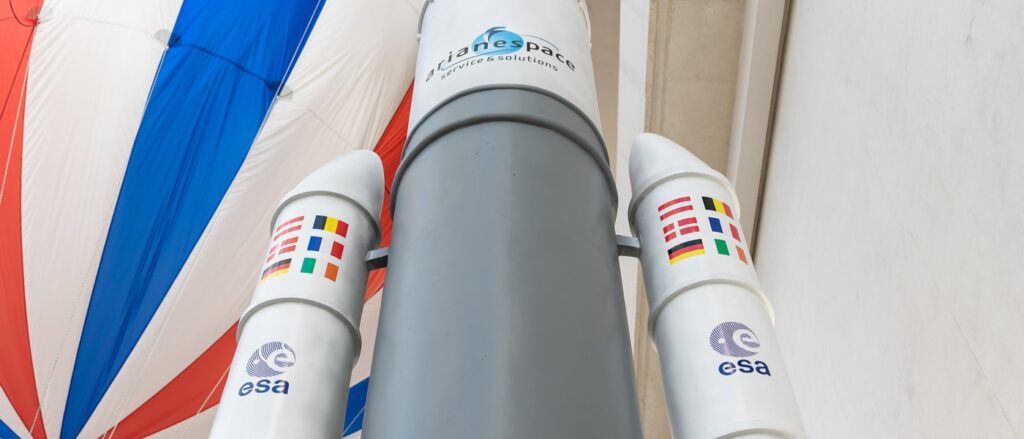
Europe’s dependence on the U.S. in space is not exclusive to military capabilities; it is also commercial. Much of the launch infrastructure underpinning Europe’s access to space is tied to U.S. companies: Currently, Europe relies heavily on launch providers outside of Europe, most notably SpaceX, among several other companies. European companies such as ArianeGroup and Avio play a central role in European launch capabilities, yet ArianeGroup’s flagship Ariane 6 rocket flew in March 2025 – five years behind schedule. The satellite navigation project mainly between the EU and European Space Agency (ESA) Galileo, developed and launched as an alternative to the American GPS, was also launched by SpaceX. The Infrastructure for Resilience, Interconnectivity and Security by Satellite (IRIS²) launched by the EU Commission aims at putting 290 satellites in orbit by 2030. This stands in stark comparison to SpaceX, which has managed to deploy over 7,000 satellites in low orbit with Starlink.
European launch services are working to catch up through initiatives like the European Launcher Challenge. France’s Guiana Space Centre remains a key launch, but compared to the U.S. having multiple launch sites, Guiana offers only one and the Andøya Spaceport in Norway is only beginning testing in March 2025. U.S. commercial space sector, through companies like SpaceX, has become an essential layer in Europe’s broader satellite launch ecosystem. Until Europe ensures reliable access to orbit, it will remain strategically dependent.
The Structural Weakness Beneath Europe’s Space Vision
For Europe, U.S. space dominance presents both a challenge and an opportunity. The U.S. has been highly effective in harnessing private enterprise to advance public objectives. In recent years, European space policy has undergone substantial evolution reflected across several EU policy documents and ultimately consolidated in the formulation of the European Space Policy and its key milestones. Despite increasing efforts to harmonize and unify space-related legislation within the EU, Member States continue to act independently, resulting in a landscape defined by differing national priorities and structural fragmentation.
Europe does not completely lack the industrial capacity to meet its goals, but its capabilities in aerospace innovation are limited. Most European firms operate within rigid national frameworks, serving their own space agencies rather than competing across borders. This is not only due to a lack of European coordination but a lack of public spending, which mitigates most private risks in the industry. The ESA’s “geographic return” principle — allocating industrial contracts in proportion to member states’ financial contributions to the agency — reinforces inefficiency in public spending and fragmentation in Europe’s space market.
Given the current U.S administration’s drastic shift from historical U.S. foreign policy toward Europe, Europe’s space domain could risk being caught in the riptide. Increasing dependence on non-European commercial actors and their technology poses a significant risk of being compromised.
Autonomy Where It Matters, Partnerships Where They Work
Rather than chasing complete space sovereignty, Europe must embrace space pragmatism by leveraging autonomy where essential, and interdependence where advantageous. The path forward requires balancing ambitions with realism: autonomy where it matters, partnerships where they are efficient.
In an international environment increasingly shaped by transactional norms – in which cooperation is more contingent, interest-driven, and subject to rapid policy shifts – such dependencies carry growing strategic risks. The lack of sovereign or sufficient space capability in critical areas among European countries means that they remain dependent on the US to either fill the gaps or to bolster the limited European capacity.
Europe knows the required steps they need to take to restore their space agenda’s competitiveness. Regulations such as the EU Space Act introduce EU-level obligations for private companies to ensure that supply chains and services sourced from non-EU countries remain secure and uninterrupted, even in adverse security circumstances.
During the meantime Europe needs to further its’ investments in launch capabilities, industrial reform, public-private collaboration as well as strategic regulation. Taken together, these measures align closely with the recommendations of the Draghi report, which emphasizes structural reform, strategic investment, and independent launch capability as pillars of European competitiveness in the space sector.

Sara von Bonsdorff är praktikant på ”the Europe, Russia, and Eurasia program” hos Center for Strategic and International Studies (CSIS) i Washington, D.C. Artikeln kan också läsas på CSIS hemsida.